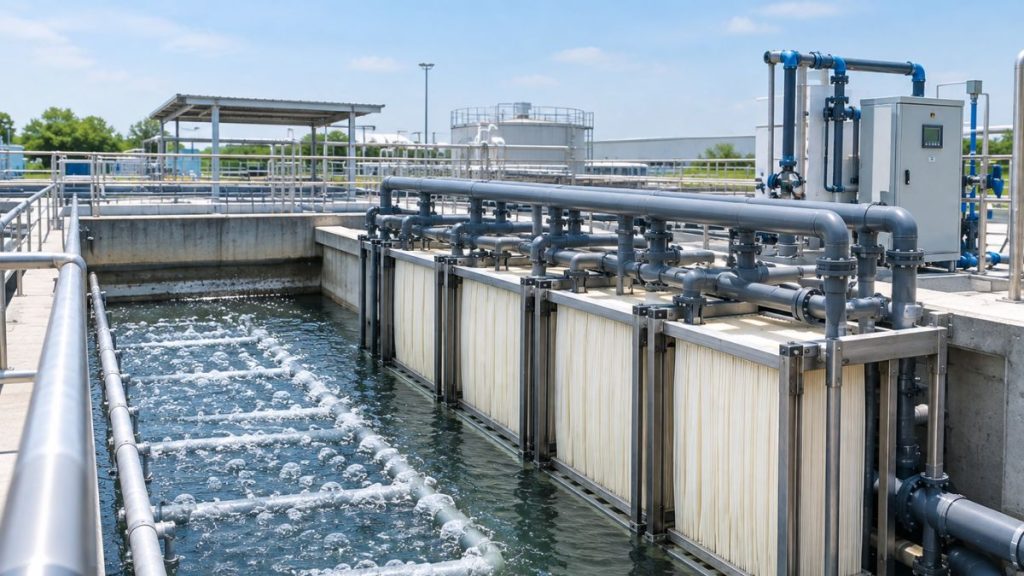
A membrane bioreactor (MBR) is a wastewater treatment technology that combines biological treatment with membrane filtration. This combination allows wastewater to undergo biological treatment while membranes separate treated water from suspended solids and microorganisms.
MBR is increasingly used for applications where high effluent quality, limited space, or water reuse are important considerations. Compared with conventional activated sludge systems, MBR replaces the conventional secondary clarification process with membrane filtration, providing more effective solid-liquid separation. However, membrane fouling, energy consumption, and operating conditions need to be carefully managed for long-term performance.
How Does a Membrane Bioreactor Work?
A membrane bioreactor combines two main treatment processes: biological degradation and membrane separation.
1. Biological Treatment
Wastewater enters a biological reactor where microorganisms break down biodegradable organic matter. Depending on the treatment objectives, the biological process can also be configured to support the removal of nitrogen and other pollutants.
The microorganisms are maintained at a controlled concentration in the reactor. Unlike conventional activated sludge, MBR does not depend on microorganisms settling effectively in a secondary clarifier because the membranes perform the solid-liquid separation.
2. Membrane Filtration
After biological treatment, the mixed liquor passes through membranes, typically microfiltration or ultrafiltration membranes.
The membranes act as a physical barrier. Water and smaller dissolved substances can pass through, while suspended solids and microorganisms are retained in the bioreactor. The resulting treated water, known as permeate, can achieve a high level of suspended solids removal.
This integration of biological treatment and membrane separation is the defining characteristic of MBR technology.
Read Also: Type of Membrane Fouling and How to Prevent It in Water Treatment Systems
3. Sludge and Membrane Management
Biomass cannot remain in the system indefinitely, so excess sludge needs to be removed according to the treatment process and operating conditions.
Membrane management is equally important. Materials such as suspended solids and biological substances can accumulate on the membrane surface or within the membrane pores, causing fouling. As fouling increases, membrane permeability can decline and cleaning or energy requirements may increase.
For this reason, membrane cleaning, aeration, pretreatment, and operating conditions are important considerations in MBR operation.
What Are the Advantages of MBR?
When properly designed and operated, MBR can provide several advantages for wastewater treatment.
1. High-Quality Treated Water
Membrane filtration provides effective separation of suspended solids and microorganisms from treated water. This can help MBR achieve stringent effluent quality requirements.
2. Compact Footprint
Because membrane filtration replaces conventional secondary clarification, MBR can operate with higher biomass concentrations. This can reduce the space required for biological treatment compared with some conventional systems.
3. Potential for Water Reuse
The quality of MBR permeate can make it suitable as part of a water reuse treatment train. Depending on the intended application, additional processes such as reverse osmosis or advanced treatment may still be required.
4. Suitable for Different Applications
MBR has been applied to municipal and industrial wastewater treatment. However, the appropriate configuration depends on wastewater characteristics, treatment objectives, required effluent quality, and operating conditions.
Read Also: Effectively Overcoming Membrane Fouling in Ultrafiltration Systems
What Should Be Considered Before Implementing MBR?
MBR should be selected based on the wastewater and treatment requirements, rather than simply because it is an advanced technology.
Key considerations include:
- Wastewater flow and flow fluctuations
- Organic loading and pollutant characteristics
- Required effluent quality
- Available space
- Pretreatment requirements
- Membrane configuration
- Membrane fouling potential
- Sludge management
- Energy consumption
- Cleaning and maintenance requirements
- Long-term operation and maintenance
Membrane fouling is particularly important because it can affect permeability, cleaning frequency, and overall operating costs. Research on full-scale MBR applications has identified fouling and energy consumption among the key challenges that need to be addressed during design and operation.
This is why MBR performance depends not only on membrane selection, but also on how the complete treatment process is designed and operated.
Designing the Right MBR Approach With LAI
At PT Lautan Air Indonesia (LAI), wastewater treatment solutions are developed according to the specific requirements of each application. MBR can be considered as part of an engineered wastewater treatment system when its process characteristics are appropriate for the wastewater and required effluent quality.
LAI supports wastewater treatment projects through engineering, process evaluation, system integration, and operation and maintenance. The approach considers wastewater characteristics, treatment objectives, process configuration, and operational requirements to develop a treatment system suited to actual plant conditions.
For facilities considering MBR, the key question is not simply whether MBR can treat the wastewater. It is whether the technology can be properly integrated and operated to meet the facility’s treatment objectives over the long term.
Need a Wastewater Treatment Solution?
Choosing a wastewater treatment technology starts with understanding the wastewater itself.
If your facility is evaluating membrane bioreactor technology, upgrading an existing WWTP, or looking for a suitable treatment configuration, LAI can help assess your wastewater treatment requirements and develop an engineered solution based on your operational needs.
Contact Lautan Air Indonesia to discuss your wastewater treatment requirements.
Reference
- Al-Asheh, S., Bagheri, M., & Aidan, A. (2021). Membrane bioreactor for wastewater treatment: A review. Case Studies in Chemical and Environmental Engineering, 4, 100109.
- Hamedi, H., Ehteshami, M., Mirbagheri, S. A., & Rasouli, S. A. (2019). Current Status and Future Prospects of Membrane Bioreactors (MBRs) and Fouling Phenomena: A Systematic Review. The Canadian Journal of Chemical Engineering, 97(1), 32–58.
- Xiao, K., Liang, S., Wang, X., Chen, C., & Huang, X. (2019). Current state and challenges of full-scale membrane bioreactor applications: A critical review. Bioresource Technology, 271, 473–481.
- Shi, Y., Wang, Z., Du, X., Gong, B., Jegatheesan, V., & Haq, I. U. (2021). Recent Advances in the Prediction of Fouling in Membrane Bioreactors. Membranes, 11(6), 381.