
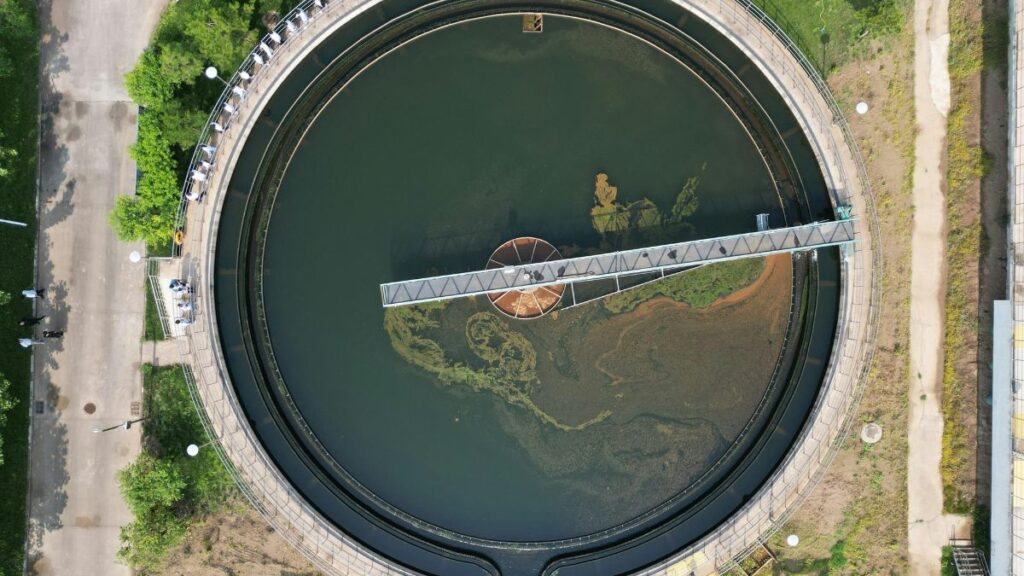
A high sludge volume index is one of the most critical operational issues in wastewater treatment because it disrupts sludge settling, reduces effluent quality, and increases operational costs. When the sludge volume index rises above the ideal range of 80 to 150 mL/g, the WWTP begins to lose control over its biological process stability. To restore system performance, operators must quickly identify the root causes and apply the right corrective actions.
High Sludge Volume Index and Its Operational Consequence
A high sludge volume index is more than a laboratory anomaly. It is a visible problem inside the secondary clarifier that affects every downstream process. When the sludge volume index increases, the sludge becomes light, poorly settling, and easily carried over into the effluent. This condition results in several direct impacts on WWTP operations:
1. Poor Separation in the Secondary Clarifier
Sludge with high sludge volume index does not settle properly, causing carry over, increased TSS, cloudy effluent, and reduced compliance.
2. Higher Risk of Sludge Bulking
A rising sludge volume index usually signals the presence of filamentous bacteria. Filament dominance creates floating, non-compact flocs that worsen sedimentation.
Read Also: Why is the Activated Sludge in Wastewater Treatment Plant Not Sedimenting Properly?
3. Increased Operational Cost
Operators must use more energy, add chemicals, increase desludging frequency, or even revive the biological system. All of these actions increase daily operational costs.
4. Lower Biological Performance
An unbalanced microbial population leads to incomplete degradation of pollutants. This results in higher COD and BOD in the final effluent.
5. Higher Risk of Non-Compliance
Poor settling due to high sludge volume index may cause violations of discharge standards such as TSS, COD, and BOD. This can result in fines, sanctions, or reputational impact.
How to Solve High Sludge Volume Index: Practical and Applied Operational Strategies
To effectively solve high sludge volume index issues, operators need an integrated and data-driven approach. The following strategies are the most widely applied in industrial WWTP operations.
1. Conduct a Microbiological Assessment of Activated Sludge
A detailed microscopic analysis is the first step required to understand why sludge volume index is increasing. This assessment identifies:
- filamentous bacteria dominance
- floc structure and compactness
- presence of organic debris
- pin flocs or dispersed growth
The results help determine what corrective actions should be taken.
2. Apply Bio-Augmentation with Selective Microorganisms
If filamentous bacteria are identified as the cause of high sludge volume index, bio-augmentation can restore system balance. This method introduces competitor microorganisms that form strong and compact flocs.
Bio-augmentation is most effective when done based on microbiological data and operational loading conditions.
Read Also: How to Control Algae and Biofilm in Raw Water Treatment Systems
3. Optimize Nutrients and C:N:P Ratio
High sludge volume index often occurs due to unbalanced nutrients. Many industrial waste streams are low in nitrogen or phosphorus. This encourages filament growth and weak flocs.
Operators should routinely evaluate and adjust the C:N:P ratio to maintain a stable microbial environment.
4. Control Dissolved Oxygen (DO) Accurately
DO levels directly influence microbial growth.
- Too low: microaerophilic filaments increase
- Too high: flocs become light and non-settling
Consistent DO control using sensors or automated blowers is crucial to prevent fluctuations that lead to high sludge volume index.
5. Apply Selective Chemical Treatment When Needed
Short-term chemical control may be used when the sludge volume index increases rapidly. Options include mild oxidizers such as chlorine, hydrogen peroxide, or permanganate.
These chemicals must be applied cautiously because long-term use can harm beneficial microorganisms.
6. Strengthen Routine Monitoring and Process Evaluation
High sludge volume index issues often develop gradually due to ignored operational changes. Operators should monitor:
- influent loading
- F/M ratio
- sludge age
- return sludge flow
- DO stability
- microscopic examination results
Establishing a structured monitoring routine helps prevent recurring SVI problems.
Need Support to Control Your Sludge Volume Index?
Managing sludge volume index requires accurate diagnosis, operational consistency, and the right technical interventions. If your wastewater treatment system is struggling with high sludge volume index or declining effluent quality, you can consult with an experienced technical partner.
Lautan Air Indonesia provides integrated wastewater treatment solutions supported by more than 40 years of experience in the field. Our technical team can help evaluate your biological system, analyze sludge conditions, and recommend solutions that align with your treatment goals.
Contact the Lautan Air Indonesia technical team to discuss the best approach for improving your wastewater treatment performance.