
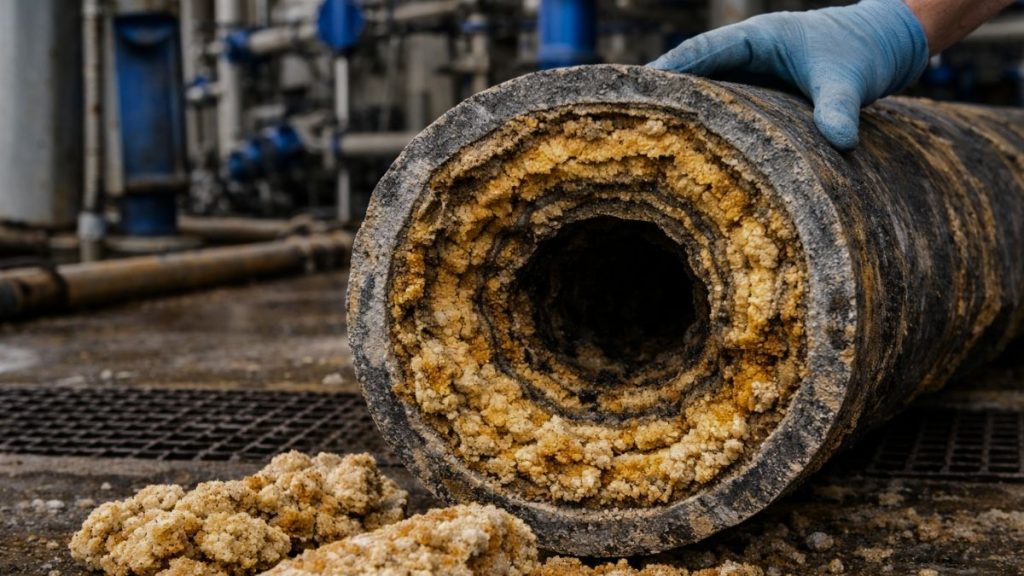
Many industrial water systems do not fail suddenly. Problems usually begin with small mineral deposits that slowly accumulate inside equipment such as heat exchangers, pipelines, boilers, or cooling towers.
Without proper scaling and deposit control, these deposits gradually reduce efficiency, increase operational costs, and damage equipment surfaces. What initially appears as a thin mineral layer can quickly develop into a serious operational problem.
This is why effective scaling and deposit control programs are essential in modern industrial water treatment operations.
Importance of Scaling and Deposit Control
Scaling occurs when dissolved minerals in water such as calcium, magnesium, silica, or iron begin to precipitate and attach to equipment surfaces. These deposits are commonly found in many industrial water systems, including:
- Cooling towers
- Boilers
- Heat exchangers
- Reverse osmosis (RO) systems
- Industrial pipelines
High temperature and pressure conditions often accelerate scale formation because mineral solubility changes and crystals begin forming on metal surfaces.
A properly designed scaling and deposit control strategy prevents these minerals from forming solid deposits. Instead, minerals remain suspended in water or are removed through treatment processes before they can accumulate.
Preventive control is critical. Once scale becomes hardened, removal requires mechanical cleaning or chemical descaling. These procedures often require partial or complete system shutdowns, which can interrupt production.
For this reason, most industries focus on preventing scale formation rather than removing it later.
Read Also: Scaling and Corrosion in Boilers: A Hidden Threat to Face
Effects of Scale and Deposits in Industrial Systems
Although scale formation may start slowly, its impact on industrial operations can be significant.
Reduced Heat Transfer Efficiency
Scale forms an insulating layer on heat transfer surfaces. In boilers, heat exchangers, and condensers, this insulation blocks efficient heat movement between fluids.
When heat transfer is reduced, equipment must work harder to achieve the same performance. This increases operating loads and energy demand.
Even a thin scale layer can significantly reduce system efficiency.
Increased Energy Consumption
Lower heat transfer efficiency forces equipment to operate longer or at higher temperatures.
This results in:
- Higher fuel consumption in boilers
- Increased electricity use in cooling systems
- Greater overall operating costs
Over time, these hidden inefficiencies can become a major operational expense.
Equipment Damage and Shorter Lifespan
Deposits can also create localized overheating and corrosion under deposits. These conditions weaken equipment materials and increase the risk of failure.
Common issues caused by scale include:
- Tube damage in heat exchangers
- Reduced boiler reliability
- Membrane fouling in RO systems
- Blockages in pipelines
If left untreated, these problems may lead to unplanned shutdowns and expensive repairs.
Higher Maintenance and Downtime
Removing hardened scale is not a simple task. Many facilities must perform mechanical cleaning or chemical descaling to restore system performance.
These maintenance activities require time, labor, and sometimes production downtime. Preventive scaling and deposit control programs help avoid these disruptions by stopping deposits before they develop.
Chemical Treatment Programs for Scale Prevention
Effective scaling and deposit control relies on chemical treatment programs designed specifically for each system.
These programs combine water chemistry monitoring, controlled chemical dosing, and operational adjustments to prevent mineral precipitation.
Several treatment components are commonly used in scale prevention programs.
Scale Inhibitors
Scale inhibitors are chemicals designed to interfere with the formation and growth of mineral crystals.
They work by disrupting crystal development so that minerals remain dissolved or suspended in the water instead of forming solid deposits on equipment surfaces.
Scale inhibitors are typically used to control deposits caused by:
- Calcium carbonate
- Calcium sulfate
- Silica
- Metal oxides
With the correct dosage and monitoring, these chemicals allow systems to operate safely even when mineral concentrations are relatively high.
Read Also: Scale Inhibitor: Practical Solutions to Prevent Scale in Water Treatment
Dispersants for Deposit Control
Dispersants help keep suspended particles separated so they do not settle or attach to equipment surfaces.
These chemicals help maintain cleaner system conditions by:
- Preventing sludge accumulation
- Reducing fouling in heat exchangers
- Maintaining cleaner pipelines and cooling systems
Dispersants are particularly useful when raw water contains suspended solids or fine particles.
Monitoring and Water Chemistry Control
A successful scaling and deposit control program also requires consistent monitoring of important water parameters, including:
- Hardness
- pH
- Alkalinity
- Total dissolved solids (TDS)
- Silica concentration
Maintaining proper water chemistry ensures treatment chemicals function effectively and scaling risks remain controlled.
System-Specific Treatment Design
Each industrial water system has unique operating conditions. Temperature, pressure, water source, and system design all influence scaling potential.
Because of this, treatment programs should always be customized rather than applied using a generic approach.
Water treatment specialists usually begin with water analysis and system evaluation before designing the most appropriate treatment strategy.
Reliable Scaling and Deposit Control with Lautan Air Indonesia
Effective scale prevention requires both the right chemicals and the right treatment program. Improper dosing or unsuitable chemical selection may lead to poor results and unnecessary operational costs.
With more than four decades of experience in industrial water treatment, Lautan Air Indonesia provides comprehensive scaling and deposit control solutions for various industrial systems.
These solutions include:
- Specialized scale inhibitor formulations
- Deposit dispersant programs
- Water chemistry monitoring
- Operational optimization for cooling systems, boilers, and RO units
By combining treatment chemicals with technical expertise, industries can maintain system efficiency, reduce maintenance requirements, and extend equipment lifespan.
A well designed scaling and deposit control program helps ensure that industrial water systems operate reliably, efficiently, and with minimal disruption.
Contact Lautan Air Indonesia to discuss your water treatment challenges and develop a scaling and deposit control strategy tailored to your operation.