
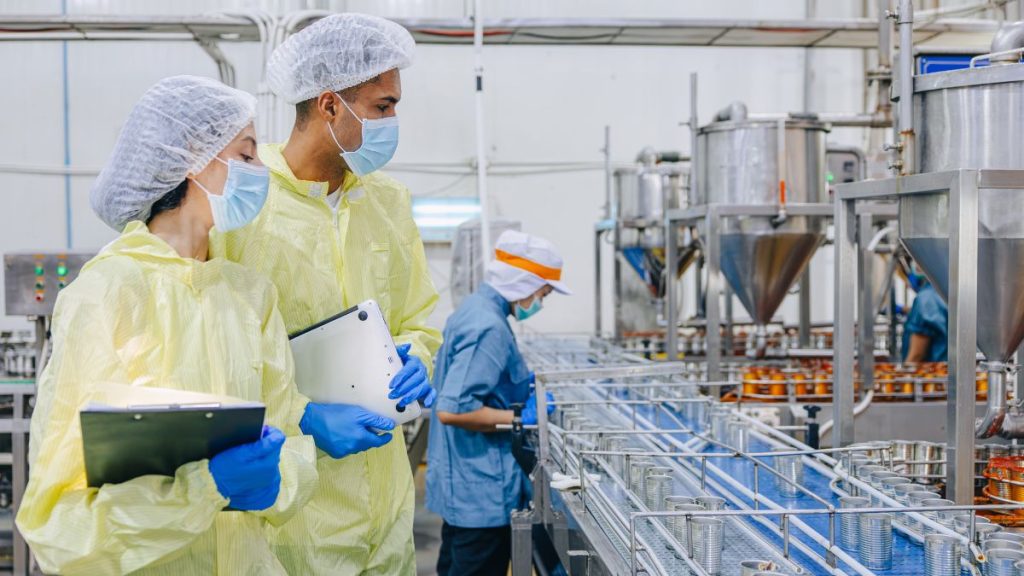
Effective cleaning and sanitizing in food manufacturing requires more than removing visible dirt from production equipment. Food residues, microorganisms, and persistent surface contamination must be managed through appropriate hygiene procedures to protect product safety, maintain quality, and support consistent production.
Understanding the differences between cleaning, sanitizing, and disinfecting helps manufacturers select suitable procedures for different contamination risks.
Cleaning: Removing Food Residues and Deposits
Cleaning removes food residues, fats, proteins, mineral deposits, and other contaminants from production surfaces. Without proper cleaning, remaining organic matter can interfere with subsequent antimicrobial treatments.
A typical cleaning procedure involves:
- Pre-cleaning: Remove loose food particles and product residues.
- Detergent application: Select a cleaning agent suited to the type of soil and surface.
- Mechanical action: Use brushing, circulation, or suitable equipment to loosen deposits.
- Rinsing: Remove loosened residues and cleaning chemicals as required.
The method should match the production process, equipment design, and type of residue. For example, fat and protein deposits may require different cleaning chemistry from mineral scale.
Cleaning is also important for controlling biofilms, which are microbial communities attached to surfaces and protected by a surrounding matrix. Research by Carrascosa et al. (2021) describes how biofilms can contribute to persistent contamination and cross-contamination in food processing environments.
Operational takeaway: Establish clear cleaning procedures and check that visible residues have been removed before proceeding to the next hygiene step.
Read Also: CIP vs Manual Cleaning: Which Method Is More Efficient for Food and Beverage Processing?
Sanitizing: Reducing Microorganisms to Acceptable Levels
Sanitizing reduces microorganisms on surfaces to levels considered acceptable under applicable food safety requirements. It is particularly important for food contact surfaces, where microorganisms may transfer to ingredients or finished products.
After cleaning, manufacturers apply a suitable sanitizer according to the established procedure. Its effectiveness depends on several factors:
- Chemical selection: Choose a sanitizer appropriate for the application and target microorganisms.
- Concentration: Maintain the specified concentration.
- Contact time: Allow sufficient time for the treatment to work.
- Application conditions: Follow requirements for temperature, water quality, and surface coverage.
- Post-treatment handling: Follow product instructions regarding rinsing, draining, and returning equipment to production.
Selecting an appropriate chemical is only part of the process. Incorrect concentration, insufficient contact time, and remaining food residues can compromise sanitation effectiveness.
A 2025 systematic review and meta-analysis by Hamilton et al. examined chemical sanitizer effectiveness against biofilms of foodborne pathogens on food processing surfaces. The findings highlight that sanitizer performance can vary depending on the microorganisms, surface characteristics, and treatment used.
Operational takeaway: Standardize sanitizer preparation and application, and verify that sanitation procedures perform as intended under actual operating conditions.
Disinfecting: Controlling Specific Microbial Hazards
Disinfecting uses chemical or physical treatments to inactivate or destroy specified microorganisms on surfaces. In food manufacturing, it may be required for selected environmental surfaces, contamination incidents, or other situations identified through risk assessment.
The distinction between sanitizing and disinfecting can vary by regulation, product labeling, and intended application. Manufacturers should therefore follow applicable requirements rather than assume the terms are universally interchangeable.
Before implementing disinfection, consider:
- The target microorganism and contamination risk.
- Surface material and condition.
- Required concentration and contact time.
- The presence of organic matter.
- Any necessary rinsing or other safety precautions.
Disinfection should not replace effective cleaning. A 2024 systematic review of biocides against Listeria monocytogenes biofilms found that treatment effectiveness can be influenced by factors including surface material, biofilm age, organic matter, and the active chemical agent.
Operational takeaway: Apply disinfection where the identified hazard and hygiene procedure justify it, using products suitable for the intended application.
Where Each Process Fits in a Hygiene Program
The three processes serve different purposes and should be incorporated into a documented hygiene program based on the facility’s products, equipment, and contamination risks.
| Process | Main purpose | Typical application |
| Cleaning | Remove residues and deposits | Tanks, pipelines, conveyors, and processing equipment |
| Sanitizing | Reduce microorganisms to acceptable levels | Food contact surfaces after cleaning |
| Disinfecting | Control specified microbial hazards | Selected environmental surfaces or targeted interventions |
In a typical food contact surface procedure, cleaning comes first, followed by sanitizing when required. Disinfection is applied where the risk assessment, applicable requirements, or established procedure calls for it.
To maintain consistent results, manufacturers should document cleaning frequency, chemical preparation, contact times, application methods, and verification activities. Visual inspections, hygiene monitoring, and microbiological testing can help identify recurring contamination and ineffective procedures.
Special attention should be given to seals, joints, drains, and other difficult-to-clean areas where residues and moisture can accumulate.
Operational takeaway: Build a hygiene program around defined procedures, appropriate chemical selection, staff training, and documented verification rather than relying on chemical treatment alone.
Read Also: Cleaning Out of Place: A Practical Guide to COP Cleaning for Industrial Hygiene and Equipment Safety
Supporting Better Cleaning and Sanitation Practices
Maintaining hygiene in food manufacturing requires cleaning chemistry and sanitation procedures suited to the production environment. The right approach should address contamination risks while remaining compatible with equipment, surfaces, and operating conditions.
Lautan Air Indonesia (LAI) supports the food and beverage, dairy, and processed food industries through its Cleaning and Sanitation (C&S) solutions, including PureRade and PureSept.
For manufacturers reviewing their existing hygiene program, evaluating cleaning effectiveness, chemical selection, and sanitation procedures can help identify opportunities to improve operational consistency and contamination control.
Looking to improve cleaning and sanitation in your food manufacturing facility? Contact Lautan Air Indonesia to discuss your operational requirements and explore suitable C&S solutions for your production environment.
Reference
- Hamilton, A. N., Jones, S. L., Baker, C. A., Liang, X., Siepielski, A., Robinson, A., Dhulappanavar, G. R., & Gibson, K. E. (2025). A Systematic Review and Meta-Analysis of Chemical Sanitizer Efficacy Against Biofilms of Listeria monocytogenes, Salmonella enterica, and STEC on Food Processing Surfaces. Journal of Food Protection, 88(5), 100495.
- Carrascosa, C., Raheem, D., Ramos, F., Saraiva, A., & Raposo, A. (2021). Microbial Biofilms in the Food Industry—A Comprehensive Review. International Journal of Environmental Research and Public Health, 18(4), 2014.
- Arthur, M., Afari, E. L., Alexa, E., Zhu, M., Gaffney, M. T., Celayeta, J. M. F., & Burgess, C. M. (2024). Recent advances in examining the factors influencing the efficacy of biocides against Listeria monocytogenes biofilms in the food industry: A systematic review. Comprehensive Reviews in Food Science and Food Safety, 24(1), e70083.
- Bachlechner, C., Zand, E., Eisenrauch, V., Mauermann, M., Jäger, H., & Schottroff, F. (2026). Biofilm properties and their implications for cleaning processes in the food industry – a review. Journal of Food Protection, 89(2), 100695.