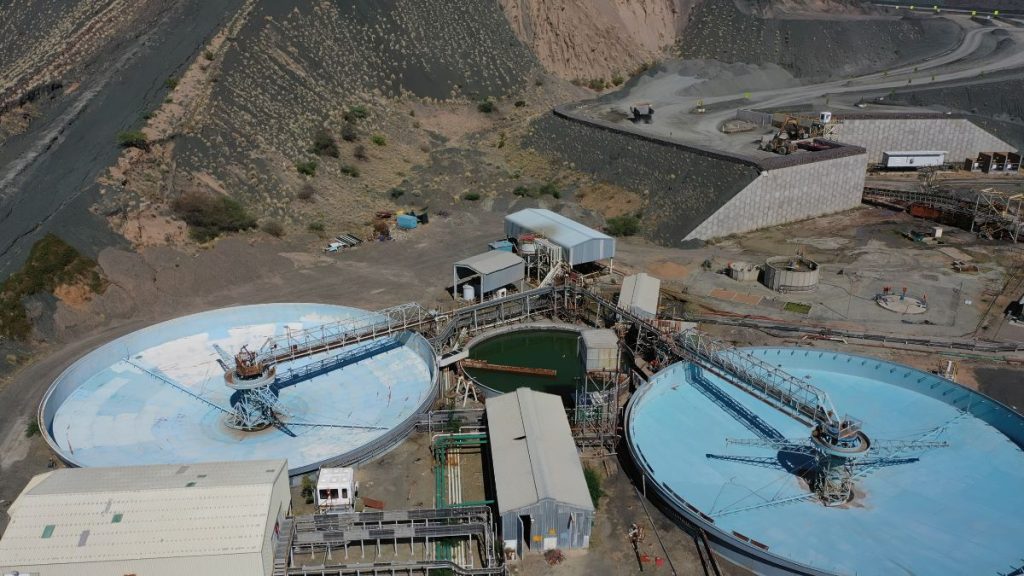
Water treatment for mining operations plays an important role in managing water used and generated throughout mining activities, from mineral processing and dust suppression to equipment washing and other site operations. These activities can generate water containing suspended solids, dissolved metals, sulfate, acidity, and other contaminants.
The treatment approach needs to address both environmental requirements and practical operating conditions. The right solution depends on the source and quality of the water, the contaminants present, and whether the treated water will be discharged, reused, or returned to the process.
The Importance of Water Treatment in Mining
Mining activities can affect water quality through mineral extraction, ore processing, waste handling, and exposure of minerals to air and water.
One important concern is acid mine drainage (AMD). It can occur when sulfide-bearing minerals are exposed to oxygen and water, creating acidic conditions that can mobilize metals. This can result in water containing elevated acidity and dissolved metals that require treatment before discharge or reuse.
Sulfate can also be a significant concern in mining-influenced water. Research has identified mining activities as an important source of sulfate, particularly through the oxidation and weathering of sulfide minerals. Depending on the required water quality, sulfate removal may require processes beyond conventional precipitation, including biological treatment, membrane processes, ion exchange, or adsorption.
Water treatment can also support water reuse within mining operations. Treating suitable water streams for reuse can reduce the demand for fresh water and help improve overall water management. Research on mineral processing wastewater highlights the importance of understanding water quality and treatment requirements when designing internal water circuits.
For mining operators, the objective is therefore not simply to remove contaminants. Treatment needs to produce water that meets the intended quality while remaining practical to operate and maintain.
Read Also: The Importance of Water Treatment for Electronics Manufacturing
How Does Mine Water Treatment Work?
There is no single treatment process that applies to every mining site. Treatment should start with water characterization to understand parameters such as pH, turbidity, suspended solids, conductivity, metals, sulfate, and other site-specific contaminants.
A treatment system may then combine several processes.
1. Physical treatment
Screening, sedimentation, clarification, and filtration can remove suspended solids and particulate matter. This stage can also reduce the solids load entering downstream treatment processes.
2. Chemical treatment
Coagulation and flocculation can improve the separation of fine particles. Chemical precipitation may also be used to remove dissolved metals by converting them into forms that can be separated from the water.
3. Biological treatment
Biological processes can be applied for specific contaminants and site conditions. Passive treatment approaches, including constructed wetlands and bioreactors, have also been studied for mining-influenced water.
4. Advanced treatment
When higher water quality is required, technologies such as ultrafiltration, reverse osmosis, adsorption, or ion exchange can be integrated into the treatment train. Research continues to explore combinations of conventional and advanced processes for mine water treatment.
The important consideration is how these processes work together.
For example, membrane systems may require suitable pretreatment to control fouling and scaling. Chemical treatment can generate sludge that requires further handling. Changes in flow or influent quality can also affect treatment performance.
This is why water treatment for mining operations should be designed around the actual water characteristics and operating conditions rather than selecting a technology in isolation.
A Practical Approach to Mining Water Treatment
A practical treatment strategy can follow four key steps:
Characterize the water → Define the treatment target → Select and integrate the treatment process → Monitor and optimize operation.
The treatment target should be established early. Water intended for discharge may require a different treatment approach from water intended for process reuse, equipment washing, or dust suppression.
Monitoring is also important after commissioning. Changes in water quality, flow, chemical consumption, or treatment performance can indicate when process adjustments or maintenance are required.
For this reason, mine water treatment is closely connected to day-to-day operation. Process design, equipment selection, chemical dosing, monitoring, and maintenance all contribute to the performance of the overall system.
Read Also: What Is Dissolved Air Flotation (DAF) in Wastewater Treatment?
An Integrated Approach to Water Treatment for Mining Operations
Implementing a treatment system involves more than selecting equipment. The process needs to fit the site’s water characteristics, treatment objectives, operating conditions, and long-term management requirements.
PT Lautan Air Indonesia (LAI) provides integrated water and wastewater solutions that can include engineering, treatment systems, equipment, process control, monitoring, and operation and maintenance.
Depending on the requirements of the site, different treatment processes can be combined to address suspended solids, dissolved contaminants, or other water quality challenges. The treatment approach can also be developed with consideration for operational monitoring and maintenance.
Need to Address Water Quality Challenges at Your Mining Site?
Every mining operation has different water characteristics and treatment requirements.
If your site is evaluating wastewater treatment, water reuse, or improvements to an existing treatment system, LAI can help assess the water treatment requirements and develop a solution suited to your operational conditions.
Contact Lautan Air Indonesia to discuss your mining water treatment requirements.
Reference
- Runtti, H., Tolonen, E. T., Tuomikoski, S., Luukkonen, T., & Lassi, U. (2018). How to tackle the stringent sulfate removal requirements in mine water treatment-A review of potential methods. Environmental research, 167, 207–222.
- Fernando, W. A. M., Ilankoon, I. M. S. K., Syed, T. H., & Yellishetty, M. (2018). Challenges and opportunities in the removal of sulphate ions in contaminated mine water: A review. Minerals Engineering, 117, 74–90.
- Ighalo, J. O., Kurniawan, S. B., Iwuozor, K. O., Aniagor, C. O., Ajala, O. J., Oba, S. N., Iwuchukwu, F. U., Ahmadi, S., & Igwegbe, C. A. (2022). A review of treatment technologies for the mitigation of the toxic environmental effects of acid mine drainage (AMD). Process Safety and Environmental Protection, 157, 37–58.
- Witecki, K., Polowczyk, I., & Kowalczuk, P. B. (2022). Chemistry of wastewater circuits in mineral processing industry: A review. Journal of Water Process Engineering, 45, 102509.
- Kleinmann, B., Skousen, J., Wildeman, T., Hedin, B., Nairn, B., & Gusek, J. (2021). The Early Development of Passive Treatment Systems for Mining-Influenced Water: A North American Perspective. Mine Water and the Environment, 40(4), 818–830.