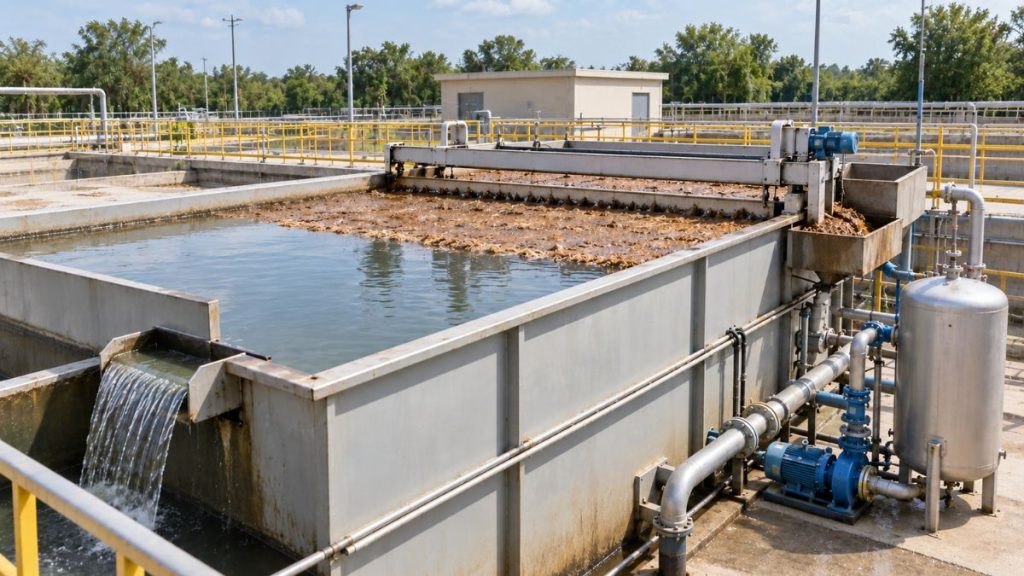
Dissolved Air Flotation, commonly known as DAF, is a wastewater treatment process used to separate suspended solids, oil and grease, colloidal particles, and other contaminants from water. Unlike conventional sedimentation, which relies on particles settling by gravity, DAF uses tiny air bubbles to float contaminants to the water surface for removal.
For industrial wastewater, DAF can be an effective solution when wastewater contains high levels of suspended solids, oil and grease, or particles that are difficult to settle. It is commonly used as a primary or pretreatment step before biological treatment, filtration, or other downstream processes. Research has also demonstrated its application in treating wastewater from industries such as food processing, textiles, mining, and other manufacturing sectors.
How Does Dissolved Air Flotation Work?
The DAF process works by attaching small air bubbles to contaminants so that they become buoyant and rise to the surface. The floating solids are then mechanically removed, while the clarified water continues to the next treatment stage.
A typical Dissolved Air Flotation system involves several key steps:
1. Coagulation and flocculation
Chemicals such as coagulants and polymers can be added to destabilize colloidal particles and form larger flocs. This step is important because larger and stronger flocs can interact more effectively with the air bubbles during flotation. Studies have shown that coagulation and flocculation can significantly improve DAF performance
2. Air dissolution
A portion of clarified water is pressurized and saturated with air. When this pressurized water is released into the flotation tank, the pressure drop causes microscopic air bubbles to form.
3. Flotation
The microbubbles attach to suspended particles, oil droplets, and flocs. As the combined bubble-particle structures become less dense than water, they rise to the surface.
4. Sludge removal
A surface scraper removes the floating layer, producing a concentrated flotation sludge. The treated water is collected from the lower or side section of the DAF unit and sent to the next treatment process.
The size and distribution of the bubbles, chemical dosage, pH, hydraulic conditions, and characteristics of the wastewater all influence DAF performance. Therefore, operating conditions need to be adjusted according to the specific wastewater rather than applying a single standard setting.
Read Also: Automotive Wastewater Treatment: Solving Water Challenges in Modern Manufacturing
What Can DAF Remove From Wastewater?
DAF is particularly useful for contaminants that are suspended, colloidal, or lighter than water. Depending on the wastewater characteristics and treatment configuration, DAF can help reduce:
- Total suspended solids (TSS)
- Oil and grease
- Fats and other hydrophobic materials
- Colloidal particles
- Turbidity
- Some organic matter associated with suspended solids
- Certain metals when they are incorporated into or adsorbed onto flocs
For example, a 2020 study on wastewater treatment works found that DAF achieved substantial removal of fats, oils and grease, demonstrating its potential as an alternative to conventional clarification for wastewater containing these contaminants.
DAF can also be combined with other treatment technologies. Research on high-rate activated sludge systems found that coupling biological treatment with DAF enabled effective solids and organic matter removal while producing a relatively concentrated sludge.
When Should You Use Dissolved Air Flotation?
DAF is generally worth considering when conventional settling is not providing sufficient separation or when wastewater contains contaminants that are difficult to remove through gravity clarification.
It can be particularly suitable for wastewater containing:
- High oil and grease concentrations
- Fine suspended solids
- Low-density particles
- Colloidal materials
- Flocs that settle poorly
- Variable or high suspended-solid loads
For example, DAF has been investigated for fish processing wastewater because of its ability to remove oil, grease, and suspended solids. It has also been studied for textile wastewater and other industrial applications.
However, DAF should not automatically replace sedimentation or biological treatment. The right configuration depends on wastewater characteristics, required effluent quality, available space, chemical consumption, sludge handling requirements, and the overall treatment objectives.
Read Also: Treat Emulsion Oil in Water: Understanding Oily Waste Types and Their Solutions
How to Improve DAF Performance
A DAF system can only perform effectively when its operating conditions are properly matched to the wastewater. Several factors should be monitored and optimized.
1. Optimize coagulation and flocculation
Poor coagulation can result in small or weak flocs that are difficult to float. Jar testing can help determine the appropriate coagulant type, dosage, pH, and polymer requirements before full-scale operation.
2. Control air-to-solids conditions
The amount of dissolved air needs to be sufficient to provide effective flotation without unnecessary energy consumption. Pressure, recycle flow, and air saturation conditions can therefore affect performance.
3. Monitor wastewater characteristics
Changes in TSS, oil and grease, pH, temperature, and wastewater flow can influence DAF performance. Consistent monitoring allows operators to adjust chemical dosage and operating parameters when the wastewater changes.
4. Manage flotation sludge properly
DAF produces a concentrated sludge layer that needs to be continuously or periodically removed and managed. Sludge handling should therefore be considered as part of the overall treatment system, not as a separate issue. Research has highlighted the importance of managing DAF slurry because it can contain both floating and settling materials.
5. Evaluate DAF as part of the complete treatment system
DAF performance should be evaluated based on what happens before and after the unit. Effective pretreatment can reduce the contaminant load entering downstream biological or membrane processes. Recent research has also shown the potential of DAF as pretreatment to improve downstream membrane performance and reduce fouling.
A Practical Approach to Selecting DAF for Wastewater Treatment
Choosing a DAF system should start with the wastewater problem rather than the equipment itself.
A practical evaluation can include:
Wastewater characterization → Treatability testing → Chemical selection → DAF design → Pilot or full-scale implementation → Performance monitoring
Wastewater characterization identifies the main contaminants and their concentrations. Treatability testing can then determine whether coagulation, flocculation, and flotation can achieve the required separation.
This approach is especially important because the optimum DAF conditions can vary significantly between wastewater sources. Research has identified factors such as pH, coagulant concentration, saturation pressure, and wastewater characteristics as important variables affecting flotation performance.
How LAI Can Support Your Wastewater Treatment Needs
Selecting and operating a DAF system effectively requires more than installing a flotation unit. The chemical treatment, process configuration, operating parameters, and downstream treatment all need to work together.
Lautan Air Indonesia (LAI) can support industries in evaluating and developing wastewater treatment solutions based on their specific water and wastewater characteristics. This can include treatment chemical selection, process evaluation, equipment solutions, and operational support.
Rather than applying the same treatment configuration to every facility, the approach can be adjusted according to wastewater quality, treatment targets, operating conditions, and the requirements of the overall wastewater treatment plant.
For industries considering Dissolved Air Flotation to address high TSS, oil and grease, or difficult-to-settle particles, a wastewater assessment and treatability evaluation can help determine whether DAF is the right solution and how it should be integrated into the existing treatment process.
Looking for the right wastewater treatment solution for your facility? Contact us to discuss your wastewater characteristics and treatment requirements with our team.
Reference
- Collin, T. D., Cunningham, R., Asghar, M. Q., Villa, R., MacAdam, J., & Jefferson, B. (2020). Assessing the potential of enhanced primary clarification to manage fats, oils and grease (FOG) at wastewater treatment works. Science of the Total Environment, 728, 138415
- Cagnetta, C., et al. (2019). High-rate activated sludge systems combined with dissolved air flotation enable effective organics removal and recovery. Bioresource Technology, 290, 121833.
- Esfandiari, A., & Mowla, D. (2021). Investigation of microplastic removal from greywater by coagulation and dissolved air flotation. Process Safety and Environmental Protection, 151, 341-354.
- Santos, M. A., Capponi, F., Ataíde, C. H., & Barrozo, M. A. S. (2021). Wastewater treatment using DAF for process water reuse in apatite flotation. Journal of Cleaner Production, 308, 127285.
- Ladouceur, J. D., Narbaitz, R. M., & Lan, C. Q. (2023). Dissolved air flotation pretreatment for low-pressure membranes in water treatment: A review of fouling mitigation and product water quality. Journal of Water Process Engineering, 56, 104391.
- Shende, A. D., Rao, N. N., & Pophali, G. R. (2023). Development of an improved solids-liquid separation reactor for floatable & settleable solids in DAF slurry of a slaughterhouse. Journal of Water Process Engineering, 51, 103431.