Choosing between PAC vs alum for water treatment requires more than comparing their purchase prices. The right coagulant should remove suspended particles effectively, maintain the required treated water quality, and support stable operations without unnecessary chemical consumption.
Evaluating raw water characteristics, jar test results, and total treatment costs helps determine which option best fits a specific water treatment process.
What Is the Difference Between PAC and Alum?
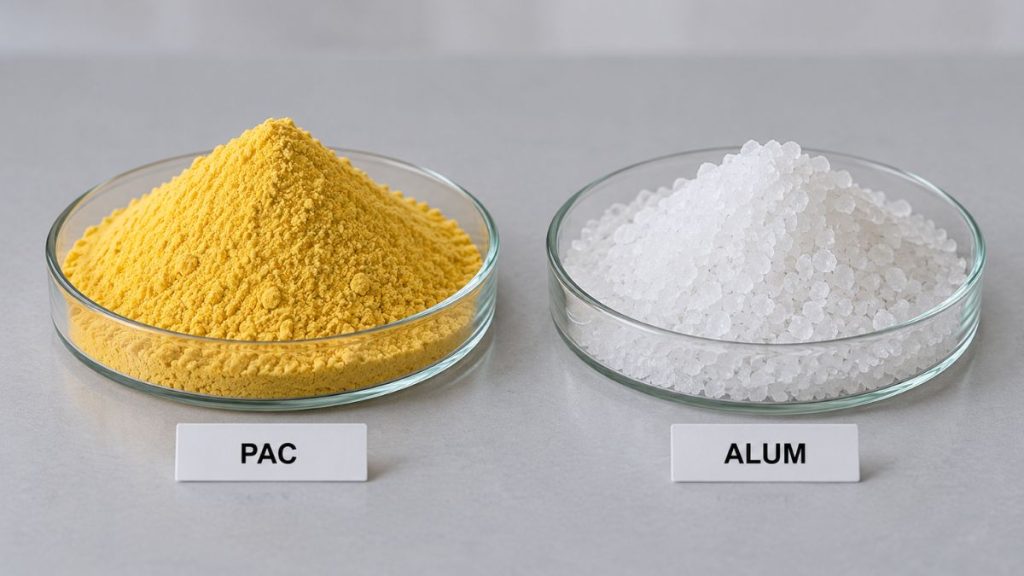
PAC (polyaluminum chloride) and alum (aluminum sulfate) are aluminum-based coagulants used to destabilize particles so they can aggregate into flocs and be separated from water. Although both serve the same general purpose, their chemical properties influence how they perform under different treatment conditions.
PAC is a pre-hydrolyzed aluminum coagulant, while alum forms active aluminum species through hydrolysis after being added to water. These differences can affect coagulation performance, alkalinity consumption, and the conditions required for effective treatment.
PAC may offer advantages in certain applications where pH stability or reduced alkalinity consumption is important. Alum remains a practical option when it consistently achieves the required treatment results at a competitive overall cost. However, neither coagulant is universally better. Research indicates that coagulant performance depends on water chemistry and the characteristics of the contaminants being removed.
How to Choose Between PAC and Alum
Selecting the right coagulant starts with understanding the water being treated and verifying performance under representative operating conditions. Three factors are particularly important when comparing PAC and alum.
1. Evaluate Raw Water Characteristics
Start by assessing the characteristics of the incoming water, including turbidity, pH, alkalinity, color, suspended solids, and natural organic matter. For industrial wastewater, additional parameters may include oil and grease, dissolved contaminants, and other process-specific pollutants.
These characteristics influence how a coagulant interacts with particles and forms flocs. Changes in rainfall, production schedules, or source water quality can also affect chemical demand.
PAC and alum may perform differently depending on the water composition and the contaminants being targeted. Research has shown that aluminum species and natural organic matter characteristics influence coagulation outcomes. Raw water analysis should therefore be the starting point for coagulant selection.
2. Compare Performance Through Jar Tests
A jar test helps determine the appropriate coagulant and dosage before making changes to full-scale operations. Testing both chemicals under comparable conditions provides a more reliable basis for evaluating their performance.
Use representative water samples and compare different dosages under consistent mixing, flocculation, and settling conditions. Where necessary, evaluate different pH conditions to identify a suitable operating range.
Key parameters to compare include:
- Turbidity and color removal: Determine whether the treated water meets the required quality targets.
- Floc formation and settling: Observe how quickly flocs form, their characteristics, and their settling behavior.
- pH and alkalinity: Assess whether the coagulant maintains suitable treatment conditions or requires additional chemical adjustment.
- Residual aluminum: Check whether the treated water meets applicable requirements.
- Downstream performance: Consider filtration, backwashing, and sludge handling where relevant.
The preferred coagulant should deliver consistent results, not simply the lowest residual turbidity in a single test. Testing should also account for variations in raw water quality when these are significant.
Read Also: The Benefits of PAC in Water Treatment: A Reliable Coagulant for Modern Industries
3. Calculate the Total Treatment Cost
Chemical purchase price alone does not determine which coagulant is more economical. A product with a lower price per kilogram may require a higher dosage or additional pH correction, increasing the overall treatment cost.
A practical comparison should include:
- Chemical consumption: Calculate the amount of product required per volume of treated water.
- pH adjustment: Include additional acid or alkali needed to maintain suitable coagulation conditions.
- Sludge management: Consider sludge handling, dewatering, and disposal costs.
- Downstream treatment: Assess the effects on filtration, backwashing, and other treatment stages.
- Operational requirements: Account for dosing adjustments, monitoring, and process control.
Commercial PAC and alum products can differ in concentration and active aluminum content. Their costs should therefore be compared on a consistent basis, alongside the amount required to achieve the same treatment target.
The most economical option is the one that consistently meets the required water quality at the lowest overall operating cost, rather than the one with the lowest purchase price.
Implementing the Right Coagulant in Your Treatment Process
Once jar test results identify a suitable coagulant, the next step is to verify its performance under actual operating conditions. A controlled evaluation helps confirm whether laboratory results translate into consistent treatment performance at full scale.
Start by establishing a baseline using current chemical consumption, treated water quality, pH, and operating costs. Then conduct a controlled trial, where feasible, to evaluate the selected coagulant under normal operating conditions.
Monitor dosage requirements, residual turbidity, sludge characteristics, and downstream treatment performance. These results can help establish practical dosing parameters and identify when adjustments are necessary.
This approach is particularly important when raw water quality fluctuates. Periodic testing and operational monitoring help ensure that the selected coagulant continues to meet treatment requirements as conditions change.
Read Also: NSF Coagulant: Ensuring Safe, High-Quality Water Treatment for Global Applications
Supporting Coagulant Selection with Lautan Air Indonesia
Choosing a suitable coagulant is part of a broader water treatment strategy. Chemical performance must align with the existing treatment process, operating conditions, and required water quality.
Lautan Air Indonesia (LAI) provides water treatment chemical solutions and technical support for industrial and water treatment applications. By considering raw water characteristics and treatment requirements, LAI can help customers evaluate suitable chemical options and identify opportunities to improve dosing efficiency and process performance.
Looking to evaluate PAC vs alum for your water treatment process? Contact Lautan Air Indonesia to discuss your water quality parameters, current chemical consumption, and treatment objectives. A process-based assessment can help identify a coagulant strategy suited to your operational needs.
Reference
- Lapointe, M., Papineau, I., Peldszus, S., Peleato, N., & Barbeau, B. (2020). Identifying the best coagulant for simultaneous water treatment objectives: Interactions of mononuclear and polynuclear aluminum species with different natural organic matter fractions. Journal of Water Process Engineering, 40, 101829.
- Dayarathne, N., Angove, M. J., Aryal, R., Abuel-Naga, H., & Mainali, B. (2020). Removal of natural organic matter from source water: Review on coagulants, dual coagulation, alternative coagulants, and mechanisms. Journal of Water Process Engineering, 40