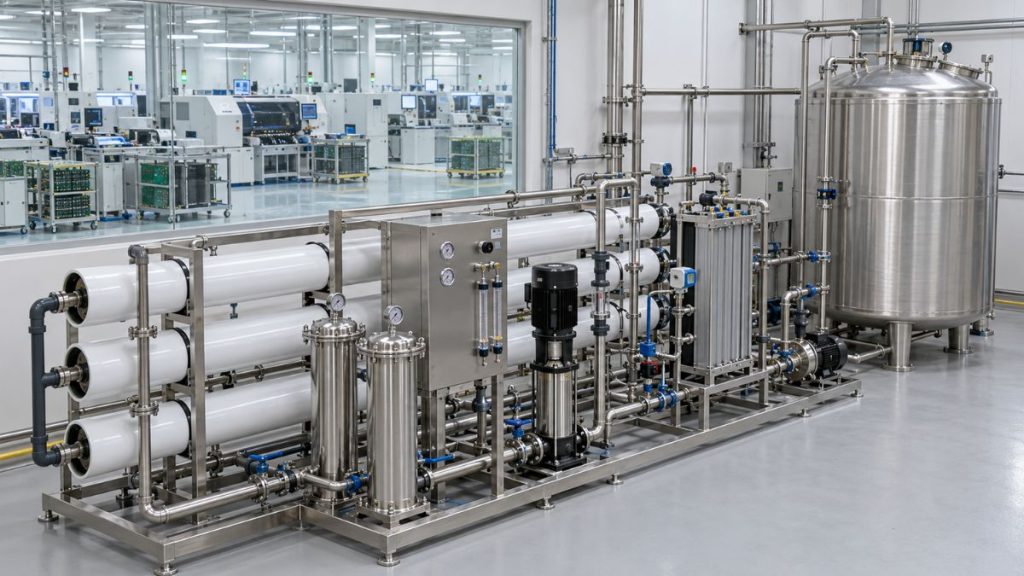
Water treatment for electronics manufacturing plays an important role in maintaining process quality, managing wastewater, and supporting efficient water use. From wafer cleaning and rinsing to cooling and other utilities, electronics manufacturing requires water with carefully controlled characteristics.
As manufacturing processes become more advanced, managing water quality at different stages of production becomes increasingly important.
The Importance of Water Treatment for Electronics Manufacturing
Water is used throughout electronics and semiconductor manufacturing, but different applications require different levels of water quality. Some processes require ultrapure water (UPW), while others can use treated water with less stringent specifications.
Here are several reasons why water treatment matters:
1. Maintaining Process Water Quality
UPW is commonly used for sensitive semiconductor processes such as:
- Wafer cleaning
- Rinsing
- Photolithography
- Etching
- Electroplating
Even small concentrations of contaminants can affect sensitive manufacturing processes. UPW systems therefore use multiple treatment stages to control parameters such as dissolved ions, organic compounds, suspended solids, and microorganisms.
Depending on the incoming water quality and required specifications, treatment may include:
- Pretreatment and filtration
- Reverse osmosis
- Ion exchange
- Ultraviolet treatment
- Membrane filtration
- Degasification
The treatment train needs to be designed around the required water quality rather than relying on a standard configuration for every facility.
Read Also: What Is Dissolved Air Flotation (DAF) in Wastewater Treatment?
2. Managing Complex Manufacturing Wastewater
Water treatment is also needed after water has been used in production.
Electronics and semiconductor facilities can generate wastewater from processes such as:
- Wafer cleaning and rinsing
- Chemical mechanical polishing (CMP)
- Etching
- Grinding
- Equipment cleaning
Depending on the process, wastewater can contain suspended solids, silica, fluoride, nitrogen compounds, organic substances, and other contaminants.
Because the composition can vary between production streams, wastewater treatment may require several processes rather than a single treatment technology. Recent research has examined combinations of coagulation, membrane filtration, adsorption, and biological treatment for semiconductor wastewater.
3. Supporting Water Reuse
Water reuse is another area where treatment can contribute to more efficient water management.
Treated wastewater may potentially be reused for selected applications when its quality meets the requirements of the intended use. For example, facilities may evaluate treated water for:
- Cooling and utility applications
- Equipment washing
- Selected production processes
- Further treatment as a source for high-purity water
Research has also explored reclaimed water as a source for UPW production. However, additional treatment may be necessary because reclaimed water can contain organic compounds and other contaminants that can affect downstream purification processes.
The key is to match water quality with the intended application rather than treating every water stream to the same specification.
4. Improving Control of the Overall Water Cycle
An effective water management strategy considers more than the treatment equipment itself.
A manufacturing facility can evaluate:
- Raw water: What contaminants enter the facility?
- Process water: What quality does each production stage require?
- Wastewater: What contaminants are generated by each process?
- Treatment: Which technologies are appropriate for each stream?
- Reuse: Where can treated water be safely reused?
- Monitoring: Which parameters need regular control?
This approach helps connect water treatment with actual manufacturing requirements and operational conditions.
Read Also: Understanding Cycles of Concentration in Cooling Towers
Building the Right Treatment Approach
There is no single water treatment configuration that fits every electronics manufacturing facility.
The treatment strategy can depend on:
- Incoming water quality
Raw water characteristics determine the requirements for pretreatment and purification. - Production processes
Different processes generate different contaminants and wastewater characteristics. - Required water quality
Water intended for UPW production requires significantly more stringent treatment than general utility water. - Wastewater requirements
Treatment needs to address the specific contaminants present in each wastewater stream. - Reuse objectives
If water reuse is considered, treatment should be designed around the quality required for the intended application.
Supporting Electronics Manufacturing Water Systems With Lautan Air Indonesia
For electronics manufacturing facilities, water treatment involves more than selecting individual technologies. The system also needs to work within the facility’s production and operational requirements.
Lautan Air Indonesia can support water treatment projects through:
- Engineering and treatment system design
- Water and wastewater treatment equipment
- Skid-based treatment solutions
- Process monitoring and control
- Operation and maintenance support
- Water reuse and treatment optimization
The approach can be developed based on the facility’s raw water characteristics, production processes, wastewater profile, and operational requirements.
This allows treatment systems to be considered as part of the facility’s broader water management strategy, from incoming water through treatment, production use, wastewater management, and potential reuse.
A More Integrated Approach to Water Management
For electronics manufacturers, effective water management requires attention to both water quality and wastewater treatment.
The right treatment approach can help facilities maintain the water quality required for production, manage complex wastewater streams, and identify opportunities for water reuse.
If you are evaluating water treatment for electronics manufacturing, contact Lautan Air Indonesia to discuss your water quality, wastewater characteristics, and treatment requirements.
Reference
- Zhang, X., Yang, Y., Ngo, H. H., Guo, W., Wen, H., Wang, X., Zhang, J., & Long, T. (2021). A critical review on challenges and trend of ultrapure water production process. The Science of the Total Environment, 785, 147254.
- Teow, Y. H., Chiah, Y. H., Ho, K. C., & Mahmoudi, E. (2022). Treatment of semiconductor-industry wastewater with the application of ceramic membrane and polymeric membrane. Journal of Cleaner Production, 337, 130569
- Sim, J., Lee, J., Rho, H., Park, K., Choi, Y., Kim, D., Kim, H., & Woo, Y. C. (2023). A review of semiconductor wastewater treatment processes: Current status, challenges, and future trends. Journal of Cleaner Production, 429, 139570