
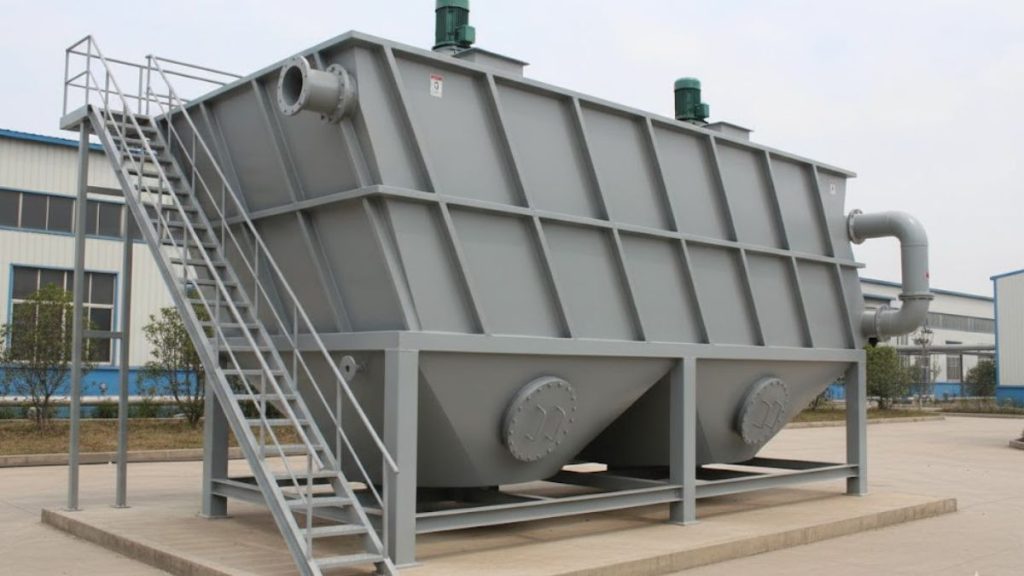
Lamella clarifiers play a crucial role in optimizing sedimentation efficiency within a compact footprint. As industries and municipalities continue to seek sustainable and space-saving solutions, lamella clarifiers have become a preferred choice for solid-liquid separation.
What Is a Lamella Clarifier?
A lamella clarifier is a type of sedimentation device used to remove suspended solids from liquids. It is designed to increase the effective settling area without requiring additional space, making it an efficient alternative to conventional clarifiers.
The term “lamella” refers to the multiple inclined plates or tubes installed inside the unit. These plates are arranged at a specific angle (typically between 55° to 60°) which allows suspended solids in the water to settle more rapidly as they move downward along the plates.
Lamella clarifiers are commonly used in:
- Drinking water treatment plants
- Industrial wastewater treatment
- Municipal wastewater facilities
- Power plants and chemical industries
Their compact design and high efficiency make them ideal for operations with limited land availability or those looking to retrofit existing treatment systems for improved performance.
Read Also: Clarifier in the Water Industry: Function, Types, and Applications
How Lamella Clarifiers Work
The working principle of a lamella clarifier is based on the concept of enhanced sedimentation. Traditional clarifiers rely on a large tank where particles slowly settle by gravity. In contrast, a lamella clarifier uses multiple inclined plates to shorten the settling distance, which increases the effective settling area per unit volume.
Here’s a step-by-step overview of the process:
1. Influent Flow
Raw water or wastewater containing suspended solids enters the clarifier from the bottom or side, depending on the design. Before entering the lamella section, the flow often passes through a distribution chamber to ensure even distribution across the plates.
2. Sedimentation Process
As the liquid flows upward between the inclined plates, gravity causes suspended solids to settle onto the surface of the plates. These solids then slide down the plates into a collection hopper located at the bottom of the unit.
3. Clarified Water Outlet
The clarified or treated water continues to move upward and exits through an outlet weir at the top of the clarifier. This water can then move on to further treatment stages, such as filtration or disinfection.
4. Sludge Collection and Removal
The settled sludge accumulated at the bottom is periodically removed, either manually or automatically, for disposal or further treatment.
Read Also: Why Is There Too Much Sludge in Clarifier?
Difference Between Lamella Clarifier and Circular Clarifier
While both lamella clarifiers and circular clarifiers serve the same purpose, removing suspended solids from water, their design, operation, and efficiency differ significantly. Understanding these differences helps operators choose the right system for their needs.
| Aspect | Lamella Clarifier | Circular Clarifier |
| Design | Features inclined plates to enhance sedimentation area. | Consists of a large circular tank where solids settle by gravity. |
| Installation Area | Compact; ideal for limited space. | Requires a large area for installation. |
| Settling Efficiency | High—due to multiple inclined plates increasing surface area. | Moderate—depends mainly on tank size and retention time. |
| Sludge Handling | Solids slide down plates into a hopper for easy removal. | Sludge is collected at the bottom and scraped mechanically. |
| Maintenance Needs | Lower, as it has minimal moving parts. | Higher, due to mechanical scrapers and larger structures. |
| Installation Flexibility | Suitable for modular or retrofit applications. | Typically installed as part of large-scale infrastructure. |
Choosing Between the Two
For new installations where space and efficiency are key priorities, lamella clarifiers offer a clear advantage. However, circular clarifiers remain relevant for large municipal plants where land is available and flow capacity requirements are high.
Ultimately, the decision should be based on operational goals, space constraints, and maintenance capabilities.
Read Also: Poor Effluent Quality in Clarifier Tanks: Identifying and Resolving Flow Rate Issues
Ensuring Reliable Operation with Professional Support from Lautan Air Indonesia
Regardless of the type of clarifier used, regular maintenance, system optimization, and water quality monitoring are essential to maintain performance and extend equipment lifespan.
This is where Lautan Air Indonesia (LAI) provides value. With more than four decades of experience in the water treatment industry, LAI delivers comprehensive services that support the operational efficiency of clarifier systems and other water treatment units.
Our Key Services Include:
- Operation & Maintenance (O&M): Professional O&M services to ensure clarifiers and other treatment units perform at optimal capacity.
- Water Treatment Chemicals: Supply of high-quality coagulants, flocculants, and disinfectants to improve sedimentation efficiency and overall water quality.
- Equipment & Controllers: Provision of reliable instruments and automation systems for efficient process control.
- Cleaning & Sanitation Solutions: Customized cleaning programs to prevent scaling, fouling, and microbial growth in clarifier systems.
- Laboratory & Monitoring Services: Accurate testing and monitoring to ensure compliance with water quality standards.
With a nationwide presence and expert technical team, Lautan Air Indonesia ensures every water treatment facility operates smoothly and sustainably.
Contact Lautan Air Indonesia today to learn how we can help you achieve reliable, efficient, and sustainable water treatment performance.