Water is a fundamental requirement in many industrial sectors. However, not all available water can be used directly for production processes. High mineral content, dissolved salts, heavy metals, or other contaminants can disrupt operations, reduce efficiency, and damage equipment. One water treatment technology that has consistently proven effective in addressing these challenges is ion exchange.
Ion exchange plays a critical role in producing water that meets specific quality requirements for industrial systems such as boilers, cooling towers, and process water applications.
What Is Ion Exchange?
Ion exchange is a chemical process where ions present in a solution are exchanged with ions attached to a solid exchange medium, typically a resin. This process alters the ionic composition of the water without changing the basic structure of the solvent itself.
Undesirable ions such as calcium (Ca²⁺), magnesium (Mg²⁺), iron (Fe²⁺), or nitrate (NO₃⁻) are removed and replaced with other ions like sodium (Na⁺) or hydrogen (H⁺), depending on the intended application.
In water treatment applications, the primary function of ion exchange is to remove ions that cause hardness, corrosion, or contamination, ensuring the treated water complies with the quality standards required for downstream processes and equipment.
How Does Ion Exchange Work in Water Treatment?
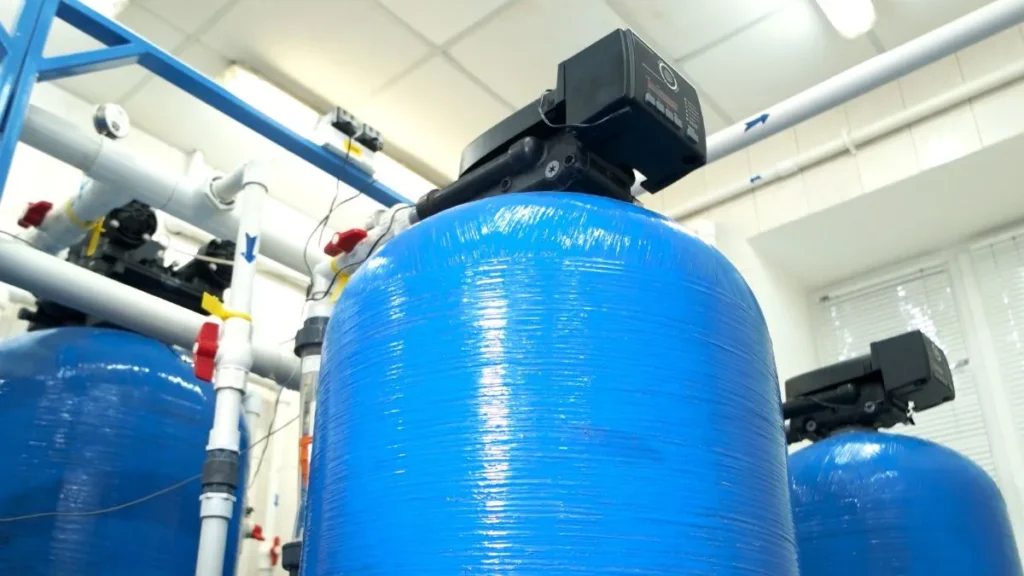
An ion exchange system typically consists of a pressure vessel filled with ion exchange resin. When water flows through the vessel, unwanted ions in the water are captured by the resin. At the same time, the resin releases ions that are more suitable for the application.
In general, ion exchange in water treatment is applied through two main processes.
1. Softening
Water softening is used to remove calcium (Ca²⁺) and magnesium (Mg²⁺) ions that cause hardness. These ions are exchanged with sodium (Na⁺), resulting in softened water that reduces scale formation in pipes, boilers, and heat exchangers.
2. Deionization (Removal of All Ions)
Deionization involves two stages: cation exchange using hydrogen ions (H⁺) and anion exchange using hydroxide ions (OH⁻). These ions combine to form pure water (H₂O). This process is widely used in industries that require high-purity water, such as electronics manufacturing, pharmaceuticals, laboratories, and boiler feedwater systems.
Beyond these primary applications, ion exchange can also target specific contaminants such as nitrates, sulfates, silica, or heavy metals. The effectiveness depends on the resin type and the design of the treatment system.
Read Also: Ion Exchange Resin: An Effective Solution for High-Quality Water Treatment
Advantages of Ion Exchange Technology
The application of ion exchange technology offers several operational and technical advantages for water treatment systems.
1. High Effectiveness
Ion exchange can remove dissolved ions to very low concentrations, making it one of the most effective technologies for achieving high water purity.
2. Precision and Selectivity
Ion exchange systems can be designed to selectively remove specific ions. This allows targeted treatment, whether the goal is hardness removal, heavy metal reduction, or full demineralization.
3. Continuous and Regenerable Process
Ion exchange resins can be regenerated periodically using appropriate chemicals. This allows continuous system operation without frequent media replacement, resulting in long-term operational efficiency.
4. Equipment Protection
Water treated through ion exchange has lower scaling and corrosion potential. This helps protect critical equipment such as boilers, heat exchangers, and piping systems, reducing maintenance frequency and extending asset life.
5. Flexible Applications
Ion exchange systems can be applied across a wide range of capacities, from small laboratory-scale units to large industrial installations. This flexibility makes the technology suitable for diverse industrial needs.
Read Also: Resin Fouling: Causes, Impacts, and How to Prevent It in Ion Exchange Systems
Trust Your Water Treatment Solutions to Lautan Air Indonesia
Each industrial process has unique water quality requirements. By understanding raw water characteristics and final water specifications, ion exchange systems can be configured to deliver stable and reliable results.
Lautan Air Indonesia provides comprehensive ion exchange solutions supported by technical expertise, decades of experience, and a nationwide service network. Our approach ensures that each system is efficient, sustainable, and aligned with operational needs.
Contact our team today for consultation on your ion exchange system requirements. We are ready to help design a solution that is reliable, cost-effective, and tailored to your process, because consistent water quality is essential to industrial success.